
Google Translate
Google Translate is a multilingual neural machine translation service developed by Google to translate text, documents and websites from one language into another.
Before setting up
Section titled “Before setting up”You can connect the Google Translate app to Google Cloud using either a Service Account key or Workload Identity Federation (WIF).
Service account key
Section titled “Service account key”-
Create or use an existing service account in Google Cloud Console (IAM & Admin → Service accounts)
-
Generate a key for for the service account in JSON format.
-
Copy key (JSON file full contents) and paste into the “Client configuration JSON string” field during connection.
Workload Identity Federation (keyless WIF)
Section titled “Workload Identity Federation (keyless WIF)”-
Blackbird supports WIF to obtain short‑lived Google credentials without storing service account keys.
-
Typical setup:
- In Google Cloud, create a Workload Identity Pool and an OIDC Provider.
- Configure the Provider to accept the Azure tokens described below.
- Grant the target Google service account the role Workload Identity User, binding it to the provider/attribute conditions.
- In Blackbird, create a WIF connection using the dedicated WIF client configuration (see “Connecting” below).
-
Azure parameters used by Blackbird:
- Issuer (URL):
https://sts.windows.net/832b2f36-ef08-4574-9237-b3458f0519d4 - Directory (tenant) ID:
832b2f36-ef08-4574-9237-b3458f0519d4 - Object ID:
5f0bdb0c-f5f3-4596-82ae-fd2ca1719cc1 - Application (client) ID:
52501bbf-4c87-464f-a96a-7eb82dbb59bf - Application ID URI (audience):
api://52501bbf-4c87-464f-a96a-7eb82dbb59bf
- Issuer (URL):
-
Configuration caveats for WIF:
- Use the Application ID URI as the audience in OIDC provider (
audclaim). - Use the Application (client) ID as the
google.subject, i.e.,google.subject = assertion.appid. - If you will impersonate a Google service account via WIF (e.g., for Translation API access), download the client configuration from the “Connected service accounts” tab in Blackbird and use it for the connection as the configuration must have
service_account_impersonation_urlparameter in it.
- Use the Application ID URI as the audience in OIDC provider (
Connecting
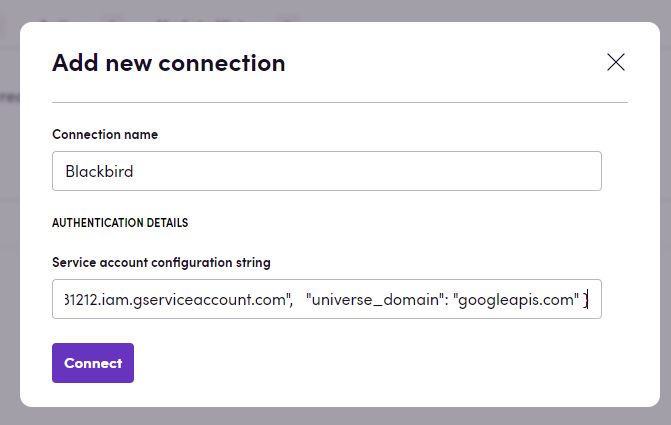
Section titled “Connecting”- Navigate to Apps, and identify the Google Translate app. You can use search to find it.
- Click Add Connection.
- Name your connection for future reference e.g. ‘Production’.
- Fill in the ‘Service account configuration string’ field with JSON content downloaded from Google Cloud Platform.
- Click Connect.
Actions
Section titled “Actions”- Translate text - Translates text to a specified language. Supports glossary, adaptive datasets and custom AutoML models.
- Translate - Translates a document to a specified language
- Supports glossary, adaptive datasets and custom AutoML models.
- Works with Blackbirds interoperable actions, so HTML, XLIFF and other Blackbird’s interoperable files could be passed as is.
- Natively supported document formats by Google itself: PDF, DOC, DOCX, PPT, PPTX, XLS, XLSX.
- Create dataset - Creates a Cloud Translation dataset for training a custom model. Optionally imports a
.tsvor.tmxfile. Files supplied directly to Blackbird are first uploaded to a user-provided Google Cloud Storage bucket. - Start custom model training - Starts training a custom model from an existing populated dataset and returns an operation name.
Google Cloud Translation requires custom datasets, custom models, and their Cloud Storage input files to use us-central1. If the user’s existing bucket is in another region, a bucket in us-central1 must be used for this workflow. The connected service account must be allowed to upload objects to that bucket. Google recommends the Storage Admin role for the complete custom-model setup flow.
Creating a custom model dataset with training data
Section titled “Creating a custom model dataset with training data”The Create dataset action can create an empty dataset or create a dataset and import training data in the same flight. Training data can be supplied either through Input file or through GCS input source URL.
Use only one of the following input modes:
| Input | Empty dataset | Input file | Existing GCS file |
|---|---|---|---|
| Input file | Empty | Select or map a .tsv or .tmx file from an earlier step | Empty |
| GCS bucket name | Empty | Bucket name only, for example translation-training-data | Empty |
| GCS folder path | Empty | Optional folder path inside the bucket | Empty |
| GCS input source URL | Empty | Empty | Full URI, for example gs://translation-training-data/en-es.tsv |
| File usage | Empty | Optional: Training, Validation, Test, or Unassigned | Optional: Training, Validation, Test, or Unassigned |
When Input file is used, the app downloads the file from Blackbird, uploads it to the specified bucket, and imports it into the new dataset. The bucket must be in us-central1. In GCS bucket name, enter only the bucket name. Do not include gs://, slashes (/), or folder paths. To upload the file into a specific folder, provide that folder in GCS folder path without gs:// or the bucket name. Uploaded files are not deleted automatically.
File usage controls how Google uses the imported file. If it is left empty, the app sends UNASSIGNED, allowing Google to split the file automatically. Select Training, Validation, or Test only when the entire file is intended for that specific purpose.
Both file input options support .tsv and .tmx files. See Google’s data preparation requirements for file contents and training requirements.
Events
Section titled “Events”- On custom model training completed - Polls the operation returned by Start custom model training and triggers once when training succeeds, fails, or is cancelled.
Feedback
Section titled “Feedback”Do you want to use this app or do you have feedback on our implementation? Reach out to us using the established channels or create an issue.