

Phrase
Phrase TMS is a software as a service platform designed to automate and streamline translating and localizing digital products, such as web or mobile apps, websites, marketing content, etc. for international markets.
Before setting up
Section titled “Before setting up”Before you can connect you need to make sure that:
- You have a Phrase TMS account on the instance you want to connect to.
In order to connect using the OAuth2 connection type, ensure that:
- You have permission to create and modify Registered OAuth apps.
- In Phrase go to Settings > Registered OAuth apps and click New.
- Fill in any name and description. For Redirect URI fill in:
https://bridge.blackbird.io/api/AuthorizationCodeand click Save. - Copy the Client ID of the newly created OAuth app.
In order to connect using the API Token connection type:
- Go to Settings > Profile > Access tokens and click Generate token.
- Under Service, select Phrase TMS. Name your token for future reference.
- Copy the value of the newly created token. You won’t be able to access it again.
Connecting
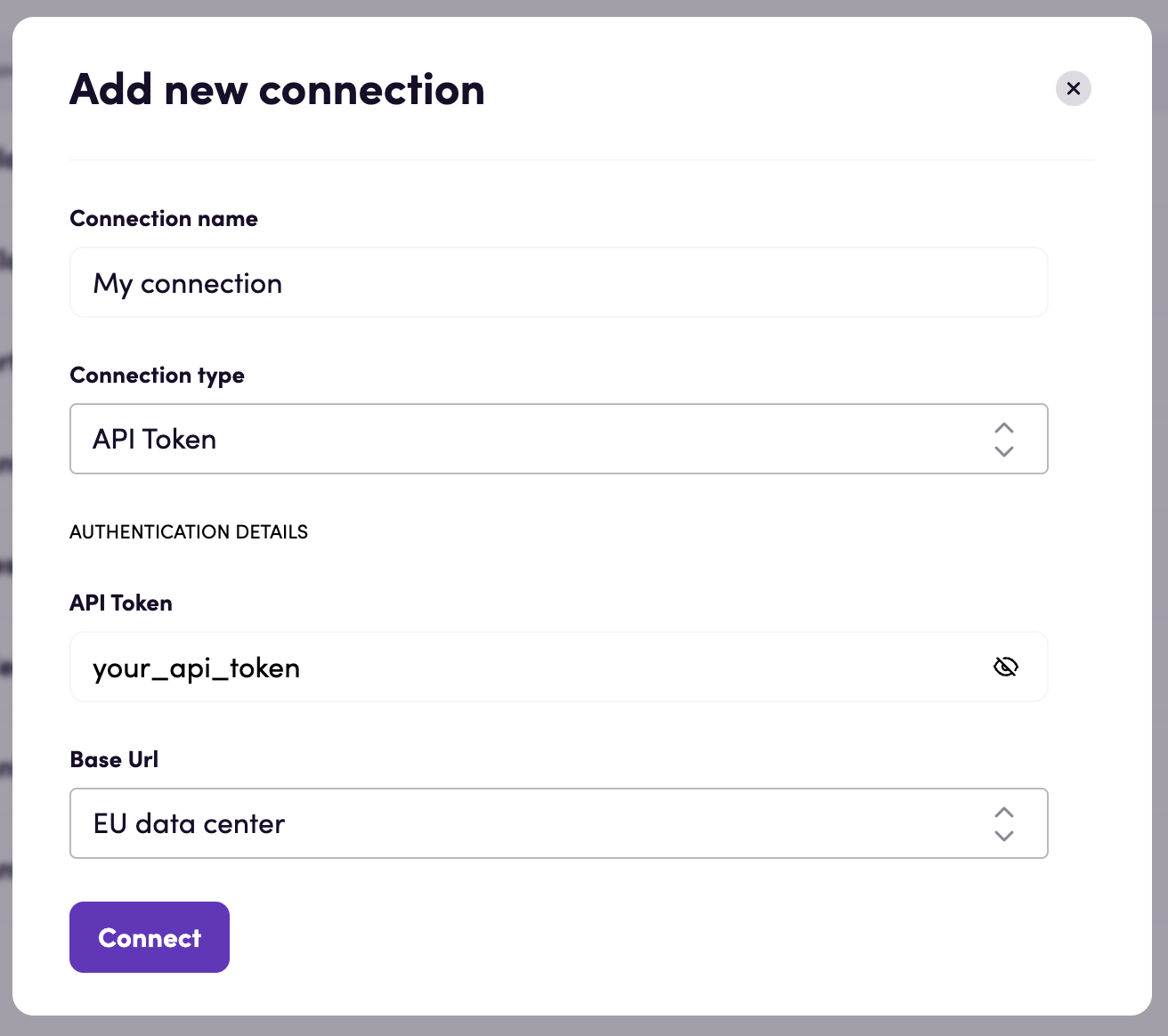
Section titled “Connecting”Navigate to apps and search for Phrase. Click Add Connection and name your connection for future reference e.g. ‘My Phrase connection’.
API Token
Section titled “API Token”- Select the API Token connection type from the dropdown.
- Fill in the API Token that you copied from Phrase.
- Select the data center your Phrase instance is hosted on. You can select between the US and EU data centers.
- Click Connect.
- Wait for the process to complete, confirm that the connection has appeared and the status is Connected.
OAuth2
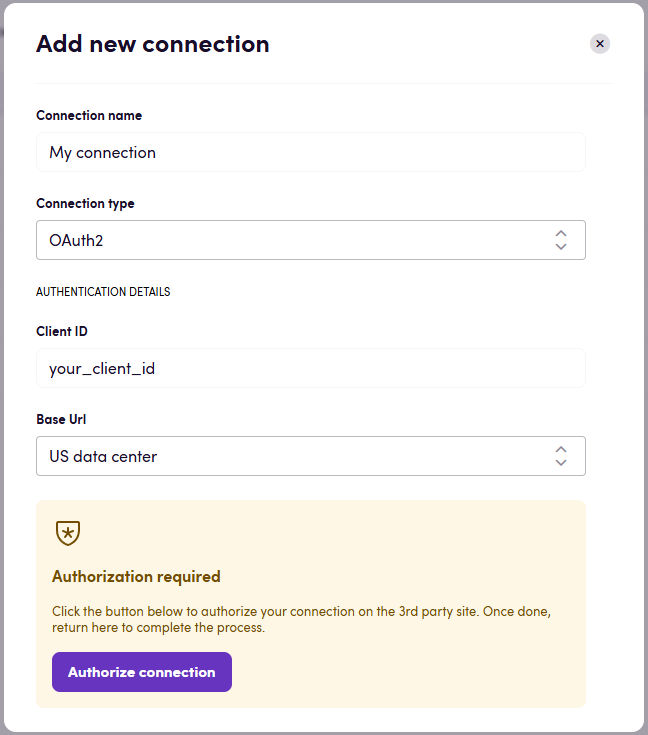
Section titled “OAuth2”- Select the OAuth2 connection type from the dropdown.
- Fill in the Client ID that you copied from Phrase.
- Select the data center your Phrase instance is hosted on. You can select between the US and EU data centers.
- Click Authorize connection.
- Follow the instructions that Phrase gives you, authorizing Blackbird.io to act on your behalf.
- When you return to Blackbird, confirm that the connection has appeared and the status is Connected.
Credentials
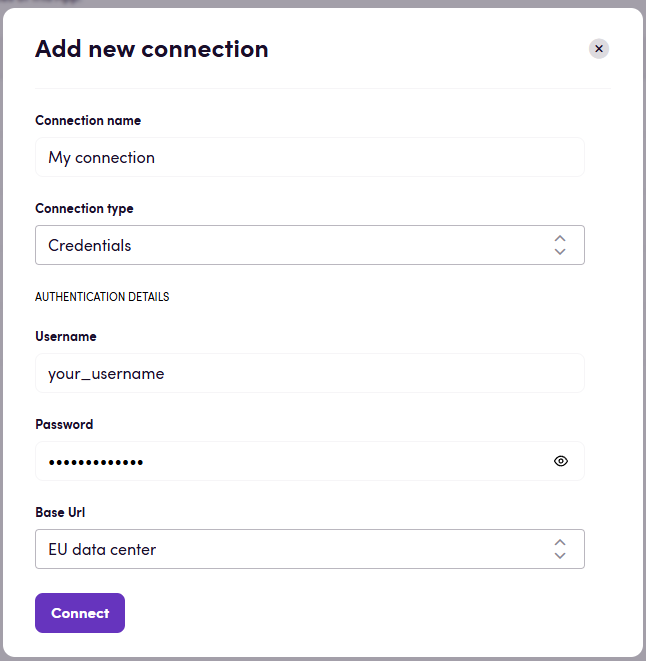
Section titled “Credentials”- Select the Credentials connection type from the dropdown.
- Fill in the username and password of your Phrase account.
- Select the data center your Phrase instance is hosted on. You can select between the US and EU data centers.
- Click Connect.
- Wait for the process to complete, confirm that the connection has appeared and the status is Connected.
Actions
Section titled “Actions”Automation
Section titled “Automation”- Update automated project settings Update specific automated project settings.
Analysis
Section titled “Analysis”- Search job analyses Search analyses for a specific job.
- Find analysis Find a single project analysis using optional filters.
- Search project analyses Search analyses for a specific project.
- Get analysis data Get full details for a specific analysis.
- Create analyses Create one or more analyses for jobs in a project.
- Download analysis file Download an analysis file.
- Export project analysis Get raw and normalized project analysis JSON output. The output of this action can be used by another app that supports importing analysis data.
- Update analysis Update provider and net rate scheme for an analysis.
- Delete analyses Delete one or more analyses.
Clients
Section titled “Clients”- Search clients Search clients on your instance.
- Get client Get details for a specific client.
- Create client Create a new client.
- Update client Update a specific client.
- Delete client Delete a specific client.
Conversations
Section titled “Conversations”- Get conversation Get a plain conversation.
- Search conversations Search conversations.
- Delete conversation Delete a plain conversation.
- Edit conversation Edit a plain conversation.
- Create conversation Create a plain conversation.
- Create multiple conversations Create multiple plain conversations.
- Create LQA conversation Create an LQA conversation.
- Add plain comment Add a plain comment.
- Edit plain comment Edit a plain comment.
- Delete plain comment Delete a plain comment.
Custom fields
Section titled “Custom fields”Custom project field actions allow you to get and set the value of fields that you have created in Phrase. Custom fields are associated with a specific type, for example date, number, or text. Each type has its own action.
- Get project text custom field value
- Get project numeric custom field value
- Get project project date custom field value
- Get project single select custom field value
- Get project multi select custom field value
- Get project URL custom field value
- Set project text custom field value
- Set project numeric custom field value
- Set project URL custom field value
- Set project date custom field value
- Set project single select custom field value
If a Custom field is not present in a project, it will be added as part of the
Setaction.
Glossaries
Section titled “Glossaries”- Create glossary Create a new glossary.
- Export glossary Export a glossary.
- Import glossary Import a glossary.
- Remove all terms from glossary Delete all terms in a glossary.
- Search jobs Search jobs in a project using specified filters.
- Export jobs to online repository Export jobs to an online repository.
- Get job Get all information for a specific job.
- Get job status changes Get status changes for a specific job.
- Find job from source file ID Find a job using a source file ID, workflow step ID, and language.
- Find job from server task ID Find a job using a server task ID, workflow step ID, and project ID.
- Upload source file (create jobs) Upload a new source file and create jobs for the configured target languages and workflow steps.
- Create jobs from remote file Create jobs from a source file available through a configured Phrase connector.
- Delete jobs Delete jobs from a project.
- Update job Update a job’s global data.
- Download job target file Download the target file of a job.
- Download job original file Download the original file of a job.
- Upload job target file Upload and update the target file of a job.
- Download job bilingual file Download the bilingual file of a job.
- Upload job bilingual file Upload a bilingual file to update a job.
- Lock segments from MXLIFF Copy locked segment IDs from an input MXLIFF file to a specific job by downloading that job’s bilingual file, applying the same locks, and re-importing it.
- Pre-translate job Pre-translate a job in a project.
- Upload job source file Upload and update the source file of a job in a project.
- Get segments count Get segment counts for a specific job.
- Get aggregated segments count (multiple jobs) Get aggregated segment counts for specific jobs in a project.
Advanced settings:
- LQA Score null?: Filter jobs by whether the LQA score is null.
- Last workflow step: Filter jobs to the last workflow step.
- Remove assigned providers from job Remove assigned providers from a job.
- Split job Split a job into multiple parts.
Miscellaneous
Section titled “Miscellaneous”- Delete all project translations Delete all translations for selected jobs in a project.
- Debug Run a debug action.
Projects
Section titled “Projects”- Search projects Search projects using the provided filters.
- Find project Find the first project matching the same filters as Search projects.
- Get project Get global data for a specific project.
- Create project Create a new project.
Advanced settings:
- Propagate Translations: Propagate translations to lower workflows when the source updates.
- Create project from template Create a new project from a template.
- Search term bases Search term bases using the provided filters.
- Add project target language Add a target language to a project.
- Update project Update project details.
- Delete project Delete a specific project.
- Download project original files Download project source files.
- Download project target files Download project target files.
Advanced settings:
- Source file ID: Download files only for a specific source file.
- Assign project providers from template Assign providers to a project or specific jobs from a template.
- Find project termbase Get the term base linked to a project based on optional filters.
- Set project translation memories Set translation memories for a project. Provide TM UIDs plus one or more parallel configuration arrays (
Read modes,Write modes,Penalties,Apply penalty to 101%-only,Orders); any provided array must match the TM UID count. - Set project term bases Set term bases for a project, optionally per target language.
- Get project providers Get providers assigned to a project.
Project templates
Section titled “Project templates”- Search project templates Search project templates using filters.
- Create project template Create a project template from an existing project.
- Set project template translation memory Assign a translation memory to a project template for all target languages and workflow steps.
- Set project template term bases Assign a term base to a project template for a specific target language and workflow step.
Quality assurance
Section titled “Quality assurance”- Download LQA assessment Download a single LQA report for a specific job ID.
- Get LQA assessment Get a specific LQA assessment.
- Start LQA assessment Start LQA assessment for a specific job part.
- Finish LQA assessment Finish LQA assessment for a specific job part.
- Run auto LQA Run auto LQA for specific job parts or all jobs in a workflow step.
- Run quality assurance Run quality checks on a job part.
Advanced settings:
- Maximum warning count: Limit the number of warnings returned, from 1 to 100.
Quotes
Section titled “Quotes”- Get quote Get a quote by ID.
- Search quotes Search quotes in a project using optional name and status filters.
- Find quote Find a single quote in a project using filters.
- Create quote Create a new project quote.
- Delete quote Delete a specific quote.
Reference files
Section titled “Reference files”- Search project reference files Search project reference files.
- Add project reference files Add project reference files.
- Download project reference file Download a project reference file.
- Delete project reference file Delete a specific project reference file.
Translation memory
Section titled “Translation memory”- Search TM Get translation memories that match search criteria.
- Create TM Create a new translation memory.
- Get TM Get a specific translation memory.
- Import TMX file into TM Import a TMX file into a translation memory.
- Export TM Export a translation memory.
- Update TM from XLIFF Update a translation memory by inserting segments from an XLIFF file.
- Insert text into TM Insert a segment into a translation memory.
- Delete TM Delete a selected translation memory.
- Edit TMs Edit translation memories.
- Search users Search users using optional filters.
- Find user Find the first user matching the search filters.
- Get user Get user information by ID.
- Add user Add a new user.
- Update user Update a specific user.
- Delete user Delete a specific user.
Workflows
Section titled “Workflows”- Get workflow step. Get details of a specific workflow step.
Events
Section titled “Events”Miscellaneous
Section titled “Miscellaneous”-
On project created Triggered when a project is created.
-
On project deleted Triggered when a project is deleted.
-
On project due date changed Triggered when a project due date changes.
-
On project metadata updated Triggered when project metadata is updated.
-
On shared project assigned Triggered when a project is shared with a vendor.
To trigger this event:
- In the vendor Phrase account, copy the vendor token.
- In the main Phrase account, go to Settings > Vendors and add the vendor using this token.
- Open a project, select Edit > Access and security, enable Use vendors, and save the project.
- Return to the project, select Share project, and assign it to the vendor.
The webhook is created and delivered in the vendor account, not in the account that shares the project. To use this event in Blackbird, connect the vendor account separately using its own credentials or API token, and configure the event with the vendor connection.
-
On project status changed Triggered when a project status changes.
-
On job created Triggered when a new job is created. Each created job starts its own flight.
-
On job deleted Triggered when a job is deleted. Each deleted job starts its own flight.
-
On continuous job updated Triggered when a continuous job is updated. Each updated job starts its own flight.
-
On job assigned Triggered when a job is assigned. Each assigned job starts its own flight.
-
On job due date changed Triggered when a job due date changes. Each affected job starts its own flight.
-
On job exported Triggered when a job is exported. Each exported job starts its own flight.
-
On job source updated Triggered when a job source file is updated. Each updated job starts its own flight.
-
On job status changed Triggered when a job status changes. For reliable checkpoint behavior, set optional filters such as Project ID, and use either Job ID or Source file ID with workflow step filters. Advanced settings:
- Project name contains: Trigger only when the project name contains a specific text.
- Project name doesn’t contains: Exclude projects where the name contains a specific text.
- Project note contains: Trigger only when the project note contains a specific text.
- Project note doesn’t contain: Exclude projects where the project note contains a specific text.
-
On all jobs in workflow step reached status Triggered when all jobs in a specific workflow step reach any specified statuses and outputs only jobs in that workflow step. Either Workflow level or workflow step needs to be provided. Advanced settings:
- Target language: Restrict the trigger to a specific target language.
-
On job target updated Triggered when a job target is updated.
-
On job unexported Triggered when a job is unexported. Each unexported job starts its own flight.
-
On analysis created Triggered when a new analysis is created.
- On user created Triggered when a new user is added. Each created user starts its own flight.
Quality assurance
Section titled “Quality assurance”- On LQA report created Triggered when a new LQA report is available in a specific project. Each report starts its own flight.
Examples
Section titled “Examples”1.4 Upload source file (create jobs) update
Section titled “1.4 Upload source file (create jobs) update”On April 25th we deployed an update that deprecated the “Create job” action in favor of the “Upload source file” action. The reason for this change was that “Create job” did not take into account the nuances of Phrase projects with workflow steps. The action “Upload source file” now always returns all the jobs that were created from the source file (multiple languages, multiple workflow steps if configured). It also returns the common denominator between these jobs namely the “Source file ID”. Similar changes to the “Search jobs” action were made. This Source file ID should be used when pairing the creation of jobs with the “On job status changed” event. Example below:
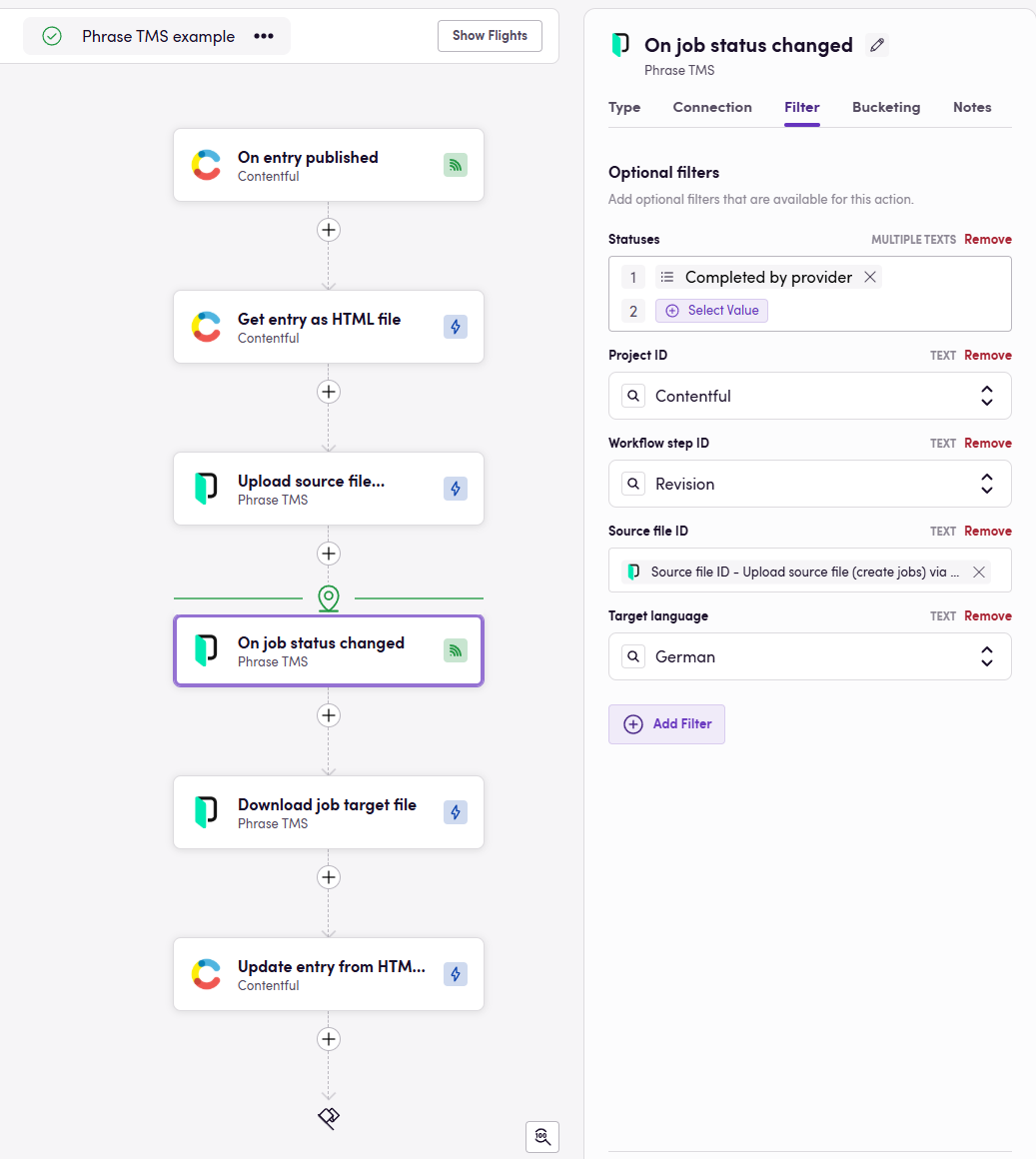
In this Bird we opt to not create a new project for each workflow. After uploading the source file we can now configure the “On job status changed” checkpoint. Required fields are at least the Project ID and either the Job ID or the Source file ID. Since the “Upload source file” action in our case returns multiple jobs, we are going to rely on the Source file ID instead.
Besides the Source file ID we can specify that we are waiting for the ‘Revision’ Workflow step ID to be triggered. This narrows down our jobs even further. From this dropdown you should be able to select any workflow step that you have configured in Phrase. Alternatively, you can use the input “Last workflow step?” to always wait for the last workflow step. This is handy when different project templates have different workflow steps.
Finally we select the status “Completed by provider” to be the moment we want to download the job target file. We have narrowed down the job enough to point at the exact job we are looking for triggering the checkpoint on and continueing our Flight.
Analysis with other systems
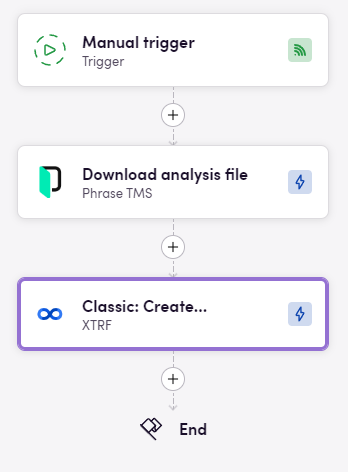
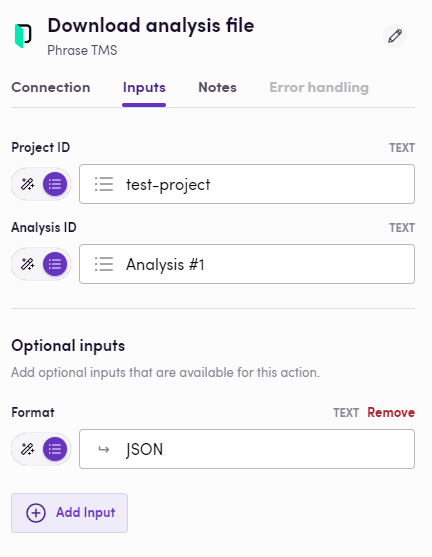
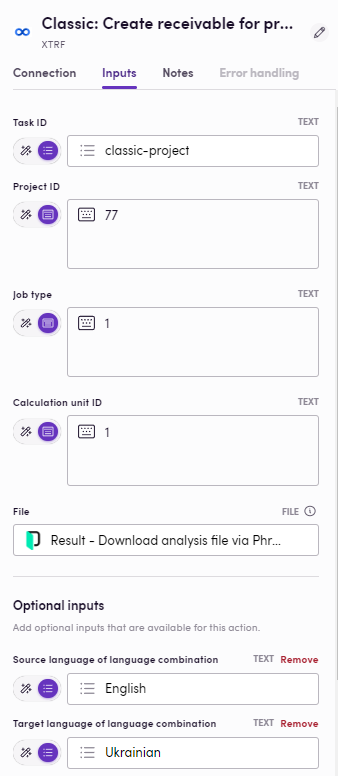
Section titled “Analysis with other systems”Our app allows you to export an analysis file (via the Download analysis file action) and use it in your workflow whenever you need it. You can also specify the format in which you want to download the file (such as JSON, CSV, or log), and then import it into the service of your choice.
Here’s an example to demonstrate this feature between the Phrase and XTRF apps:
Propagate locked segments to another workflow step
Section titled “Propagate locked segments to another workflow step”Use Lock segments from MXLIFF when you need a later job or workflow step to inherit the locked segments from an earlier Phrase MXLIFF file.
Typical flow:
- Download or otherwise obtain the source MXLIFF from the earlier workflow step.
- Run Lock segments from MXLIFF with that bilingual file plus the destination Project ID and Job ID.
- The action reads all locked translation unit IDs from the source MXLIFF, downloads the destination job’s bilingual file, applies the same locked IDs there, and uploads the updated bilingual file back to Phrase.
This is especially useful in continuous projects where locked status does not automatically propagate to the next workflow step.
Missing features
Section titled “Missing features”Not all API endpoints are covered, let us know if you are missing features or if you see other improvements!
Feedback
Section titled “Feedback”Feedback to our implementation of Phrase is always very welcome. Reach out to us using the established channels or create an issue.