

DeepL
DeepL is an artificial intelligence (AI) company that specializes in language translation services. It offers a neural machine translation (NMT) engine capable of providing high-quality translations across multiple languages. DeepL’s translation engine is known for its accuracy, natural-sounding translations, and ability to understand context.
Before setting up
Before you can connect you need to make sure that:
- You have a DeepL account.
- You have an API key for your DeepL account. It can be found under account settings in DeepL.
- Important: If you are using an API key for CAT tools, it will not work for the public API. Instead, you need to use the Authentication key for DeepL API. You can find guidance on where it is located in this guide. For more details, you can also refer to this discussion, where a similar issue was resolved.
Connecting
- Navigate to Apps, and identify the DeepL app. You can use search to find it.
- Click Add Connection.
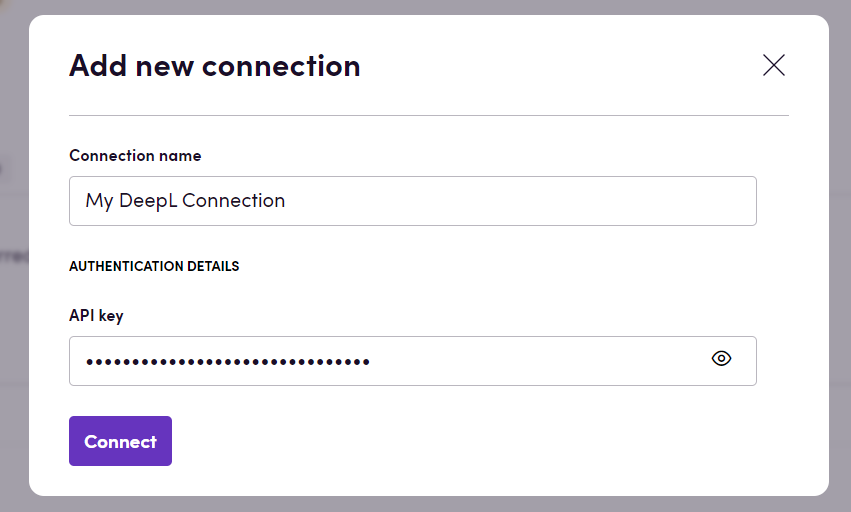
- Name your connection for future reference e.g. ‘My DeepL connection’.
- Fill in the API key to your DeepL account.
- Click Connect.
Actions
Translation
- Translate text Translate text and output translated text, detected source language, and billed characters. Advanced settings:
- Source language: Set the original language when you do not want automatic detection.
- Formality: Control how formal the output text should be when supported.
- Glossary: Apply a glossary to enforce preferred terminology.
- Style rules: Apply a style rule to guide phrasing in the output.
- Tag handling: Control how tags are interpreted during translation.
- Model type: Choose the DeepL model behavior for the translation.
- Preserve formatting: Keep formatting in the output text.
- Outline detection: Preserve outline structure in tagged content.
- Non-splitting tags: Provide tags that must stay intact.
- Splitting tags: Provide tags that may be split.
- Ignore tags: Provide tags that should not be translated.
- Context: Add extra context to improve output quality.
- Translate Translate a file and output the translated file for downstream actions. Supports glossary, style rules, and output file settings. Advanced settings:
- Glossary ID: Apply a specific glossary by ID.
- Output file handling: Choose whether the output stays interoperable or follows original format handling.
- File translation strategy: Choose DeepL native file handling or Blackbird interoperability mode.
Write
- Improve text Rewrite text and output improved text with language information. Advanced settings:
- Language: Set the output language variant for the rewrite.
- Writing style: Choose the writing style for the rewritten text.
- Tone: Choose the tone for the rewritten text.
Glossaries
Note: DeepL supports only two-letter base locale codes for glossaries (e.g., fr instead of fr-FR). The app automatically normalizes all language codes to their two-letter form. If multiple locales with different region codes are provided (e.g., se-sv and se-fi), the first one will be used and the rest will be ignored. Unfortunately, this is a limitation of the DeepL API.
- Export glossary Export a selected glossary as a TBX file.
- Import glossary Import a bilingual glossary file (TBX, CSV, or TSV) and create a glossary. Advanced settings:
- New glossary name: Override the glossary name from the imported file.
- Get glossary details Get metadata for a selected glossary.
- Get glossary entries Download entries from a selected glossary as a TSV file.
- Search glossaries Search all available glossaries.
- Delete glossary Delete a selected glossary.
- Import glossary (multilingual) Import a multilingual glossary file and create a v3 glossary with multiple language pairs.
- Update dictionary (multilingual) Update dictionaries in an existing multilingual glossary from a TBX, CSV, or TSV file.
- Export glossary (multilingual) Export a multilingual glossary as a TBX file.
- Export glossary (new) Export a glossary as TBX v3 or TBX v2. Advanced settings:
- TBX export version: Choose whether the export file is TBX v3 or TBX v2.
- Import glossary (new) Import TBX, CSV, or TSV glossary files (bilingual or multilingual) into a v3 glossary. Advanced settings:
- Name: Set a custom name for the new glossary.
- Pivot language code: Set the pivot language used for multilingual import.
- Source language code: Set a specific source language code.
- Target language code: Set a specific target language code.
- Force header row (CSV/TSV): Force CSV/TSV parsing to treat the first row as a header.
Example
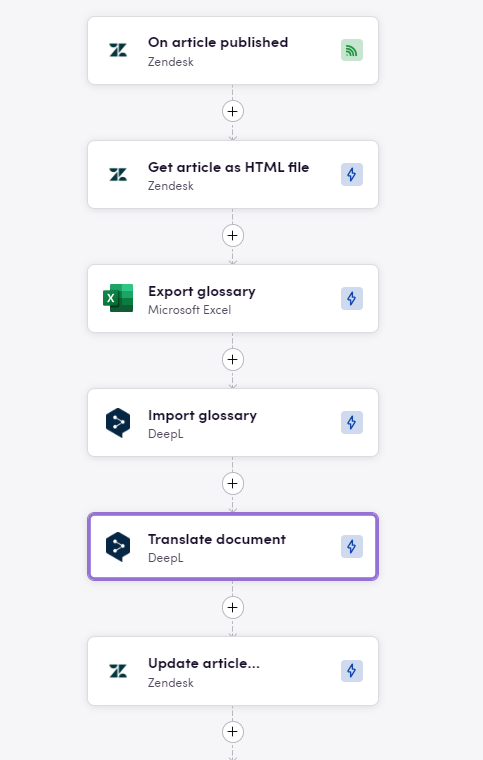
The example above shows a bird that is triggered as soon as an article is published in Zendesk, said article is then exported as an HTML document and translated through DeepL before being imported back into Zendesk. The DeepL translation also considers as guardrail a Glossary that has been exported from Microsoft Excel.
Feedback
Do you want to use this app or do you have feedback on our implementation? Reach out to us using the established channels or create an issue.